Tuesday, May 28, 2013

Where are we going?


So lately I've had a few spare moments to sit and reflect and write a bit, so I thought I'd share a recent reflection of mine. I don't know that its complete, especially because its not one isolated reflection but something that comes up again and again, each time a little more clear. Also, I wrote this reflection to myself, I guess I just find it the easiest way to clear up my ideas. But, I thought I'd open up my reflection to ya'all.

What sparked my reflection is a very definitive aspect of the peruvian culture, a basic way of interacting here. It is simple: when you arrive at an event, or when you cross paths with someone, you always greet everyone individually. When you leave, you say goodbye to everyone individually. It takes a little more time, and sometimes it bothers me because I just have one tiny little errand to run and then I add 10 minutes to completing the task.

I was also thinking about my schedule and how to best take advantage of this year as an aspirant in Lima, and through experiences of sometimes frustration and sometimes joy, I started re-evaluated my "schedule". I started seeing all the people in the "path" of my schedule, and how little I was paying attention to them.

From there I leave you with my reflection on "progress":

Well, lets consider a few definitions of progress before diving in: 1) forward or onward movement toward a destination, or 2) advance or development toward a better, more complete, or more modern condition. Both definitions, one of the physical reality and one of a condition, contain 2 elements: 1) an end and 2) getting closer to that end.

Let me now ask something more basic: Why are we questioning what progress is in the first place? Why do we seek progress? Why is it important for us? Can we live a happy life without progress?

I assert, from a purely existential point of view, that the current condition of the human is not “fulfilled”. We seek progress because we are not fulfilled, thus we must advance or progress toward this fulfillment. Every human being has the experience of not being fulfilled, and in many different ways we seek “progress”. Some examples: Working your way up in your job (promotion), working your way up in social class, advancing through your studies, working for a more just economic system, progressing toward “equal rights”, improving relationships, etc. Sometimes to remind ourselves that we are making progress, or to help satisfy that lack of fulfillment, we make a checklist that “reassures” us that we are making progress and thus approaching that fulfillment. None of these are bad, but at a certain point I think we need to stop and ask: What am I progressing toward? What are these longings for advancement that I have? Am I really progressing? When will I be fulfilled? When I get out of high school and escape to the college life? When I finish my college degree and get out into the real world? When I work my way up in the real world to the point of having a stable job and comfortable income? When I find the right man/woman to settle down with and start a family? When I can finally speak fluidly this language I am learning? When I reach the finish line of this marathon?

Do you see me? I am one among 14,000, so probably not! 
Ah, the marathon example. Let’s reflect on that a bit. In the recent half marathon that I ran, during the race I was always set on the finish line, as if there lie my eternal reward. Just keep running, just hold out a little longer, keep the pace, finish strong through the finish line! And I do remember quite vividly the gratification of achieving the goal, of crossing the finish line and meeting the goal I had set for time. It was really gratifying because the race was so long! Almost 2 hours running. But I had fought, a long and difficult battle, and I came out victorious. It was really gratifying. I just soaking in the moment for a while. And then… well, and then I started thinking about running a full marathon. I experienced fulfillment in that moment, but it couldn’t hang onto it. That sensation, that satisfaction slowly slipped through my arms, and I couldn’t hang onto it! I saw that I wasn’t fulfilled anymore. I was happy, but it wasn’t enough, I need more. I need a bigger challenge now: a full marathon. Then I will be happy. Or maybe it will be a similar experience?

Why do I ask this question now? Well, I think many people have the question, but it’s not the easiest question to answer, and so sometimes its better that it remain vague and unbothered. But we can’t hide the question forever. We find ourselves before the great adventure of life, yet awkwardly and a bit embarrassed asking the same question as Pippin when the Fellowship of the Ring begins: Where are we going?

http://www.youtube.com/watch?v=NICSLDQwwAo

I think this is what happens to many people when they reach midlife and haven’t yet answered that question… we called that a midlife crisis.

I think many of us enter a midlife crisis because our whole life has been based on values of progress, and having passed half our time on earth the see what little “progress” we can make. We experience our own limitedness, and began to ask questions like: Does progress even exist? If it does, what are we progressing towards? The top of the business world? The highest achievement board? The longest list of friends? The best fit body? The most comfortable lifestyle? The highest level of scholarship? The dean’s list? Why can’t I seem to reach a state of fulfillment, of being content? I recall an old poster I had of a band called “Staind” that says, “progress is illusion”. I’m not exactly sure what they meant, but perhaps they started catching on to this “progress” that doesn’t lead us where we think: to our own happiness. Yes, ultimately we strive for progress in whatever terms we understand it (business, knowledge, popularity, accomplishment) because we carry and underlying belief that this “advancement” will lead us to be more fulfilled, happier, and will give meaning to our lives.

Our own limitedness and the shortness of our lives is sometimes a smacks in the face. We find that we are not yet “happy”, and that the only meaning is to continue “advancing”, but because my life will end soon, what do my “advancements” really mean in the bigger picture? Advancement toward what? Or perhaps the better question is: What kind of progress leads to the fulfillment I long for? Ah! I didn’t even know I had that longing. Another question: What is that longing?

A quote from Pope Francis: “This verb, to promote: yes, it is a nice verb and one we must use in the Church. Yes, He was promoted to the Cross, He was promoted to humiliation. That is true promotion [advancement], that which makes us seem more like Jesus!"

The Christian understands progress, as the Pope mentions, in a radically different way than the our culture. Christ teaches this to his disciples as they dispute about which is the greatest among them. But the Christian doesn’t just throw the idea of progress out the window as a mere skeptic, rejecting all our culture talks about, but reflects and purifies what real progress is: growing in humility.

Humility is walking in truth, and so “growing” in humility is living ever closer and in conformation with the truth. But we don’t mean to say “truth” as in a list of declarations, like the 10 commandments or the dogmas of the Church, but we understand that “truth” is ultimately a person, meaning our longing for “truth” is most fundamentally a longing for communion. Because this person is infinite, our longing is for the infinite, and the progress we make never seems to be enough. But this is precisely what points us toward God, that we our not satisfied with something less than infinite, that we are made for the infinite.

So, progress is growing in humility, which conforming ourselves to Christ. Progress is becoming more and more like Christ, which only happens through communion, through love, relationship. If my relationship with God, with myself, and with “neighbors” (all those I come across in my path) is deepened, I am making progress, and if not, any other “worldly” progress, though good in itself, is devoid of all meaning and can even become destructive. We see this manifested in a very concrete way in the injustices of the world today amidst the wave of technological advancement.

You can even go so far as to say that with a merely horizontal vision, progress is pure illusion, and that the only true progress comes to us from the supernatural. Why? Because that is our end: eternal relationship with God. If there is no “end”, if there is no truth, than the progress I make in my life is fooling myself into believing I’m making progress (because I avoid the question “what end am I progressing toward?”). Remember, the definition of progress implies an end, a destination or ideal.

Fulfillment comes through communion, through fellowship, through solidarity, through intimacy with others. This can be a very challenging statement, especially when we think of progress only in terms of self. I am not capable of fulfilling my self. If I make some of the most incredible advancements in my work, if I learn 10 languages, if I work out 2 hours every day, if I maintain the perfect diet, if I organized 6 fundraisers to combat homelessness, if I… forget about the people connected to my checklist than I will never be satisfied with my list of “accomplishments”. But you know what, it means my list of “accomplishments” will be shorter. This bothers me for a second, but then I remember that the accomplishments (even noble ones) will never be enough, and so they really aren’t requirement for my fulfillment. Communion is required for my fulfilled, and communion cannot always be categorized neatly on a checklist. It cannot be conquered or dominated, but just encountered, as a mystery. And I think even in our relationships we will find ourselves faced with limits, never quite fully satisfied, and that is why in the end it is not just relationships with our neighbors, but a relationship with a God that is infinite. That is the direction of my "unfolding"; that is my end.
Top: Alfredo, Ernesto, Father Gilmer, Father Juan Carlos, Ernesto, 
Father Jaime, Leonardo. Bottom: Rodrigo, Me, Sean, Chris 
So as not to be end too theoretical, to come down to earth, I guess I finish by considering: What moments in my life have I experienced fulfillment? And in what I’ve discovered is truly fulfilling, am I pursuing that with all my heart, orienting my entire life, down to my daily schedule, around it? Isn’t it worth the risk?

Bebo Norman - "Here Goes" talks about taking the risk :)

http://www.youtube.com/watch?v=S97O9395rgc

Monday, March 11, 2013

The Horizon


So I’ve been thinking it’s about time I recommit myself to my blog. I guess in part that’s because I had the chance to visit you all at home and well, that’s basically the point of my blog! But, I’m back in Lima all settled in and things are getting into a pretty good rhythm!

I have to say the visit was a good chance to step back from everything I was doing here, reflect, and simply remember what brought me here in the first place. Much of my understanding of my call is the context of my life in Nebraska. Though I received several graces and learned and grew so much in my first 5 months here, the dynamic of my life is just so much different that it was difficult to understand my vocation in the same way.

That is not necessarily a bad thing, and it has certainly led me to reexamine and purify my reasons for being here, and “get back to the basics” of Christian life in several ways.

I was certainly excited to see everyone, though I must say I didn’t anticipate needing to say goodbye to everyone again.

Steak Dinner at Home-with everyone! (My mom is taking the photo)
Perhaps I can outline very practically a bit of my horizon for the next several months as summer vacations are just finishing now. I’ll do it bullet point style to try to remain faithful to my formation as an engineer!

·      Spanish Class 2 hours/day. I’ve decided to hire a cheaper, private professor (not that my classes were to expensive before) and one that lives closer by, and in general hopefully it will be a little easier and more efficient. By “one that lives closer by” I mean to say that class takes place in my room at my desk. If you haven’t guessed yet, I’m the professor J. Well, I find lessons online and read books can always can helped from the 10 people I live with that speak Spanish. And well, the listening exercise happens all day long in everything else I do.

The group of altar boys. To kick of the year we hiked up a
little mountain in Lima while praying the stations of the cross. 
·      Altar Boys. We’ve had a group of altar servers at the parish that for some time has always been led by a gringo (not sure how that tradition started, not that its important). Anyways, we usually meet on Saturday afternoons for a couple hours, and then there are masses most of the day Sunday so I just accompany them a bit as they come and go.

·      Domini Architects. So I must admit in coming down here I had pretty much no intent of using my engineering degree (other than practical ways like critical thinking, objective thinking, etc). But, it just so happens there is a Sodalit that started an architectural firm in Lima and could use some help. Well, I have pretty much no experience as an engineer or architect, but after thinking about it and talking with several people it seems like a good opportunity. At least I will get a glance at what this kind of work would look like as a Sodalit. So, the plan is to work there 3 days a week.

·      Aspirant Formation. I will meet probably twice a week with a group of 5 aspirants (first step of the discernment). These meetings can take on a variety of shapes, but basically we learn about the Sodalit style and spirituality and each other and ourselves and how all those relate. Some days are intense, some are more laid back, but I’m excited to get started with these again. We also have mass once a week just for the aspirants in Lima.

·      Religion Class. There is a school nearby call “Roosevelt” (not kidding), and all the classes are in english (well, except spanish class). I’m going to teach 11-12 year olds one day a week. If you have any pointers I’m all ears!

·      Water the Lawn. This perhaps is not essential to my formation, but some nonetheless that God as asked of me during my time here. So, I spend about 45 min a day watering the lawn (its several small sections, so sprinklers don’t work really well).

·      Half Marathon. Some of the other guys I live with have invited my to run a marathon (well, uhm, half!) so we usually go running in the mornings. Though I don’t much enjoy waking up early or running, I have always found it to be very good for me. Also, the communal aspect of pushing each other to offer the best of what you got and conquer your will is, though in the moment far from pleasant, in deeper sense quite beautiful and very fulfilling.

Of course there will be also time for prayer, for intellectual reading, for talking with other Sodalits, other aspirants, etc. which will also be essential, if not more important for my “unfolding” this year.

I hope to continue sharing stories and reflections along the way!

Tuesday, January 22, 2013

Pichacani - Who am I?


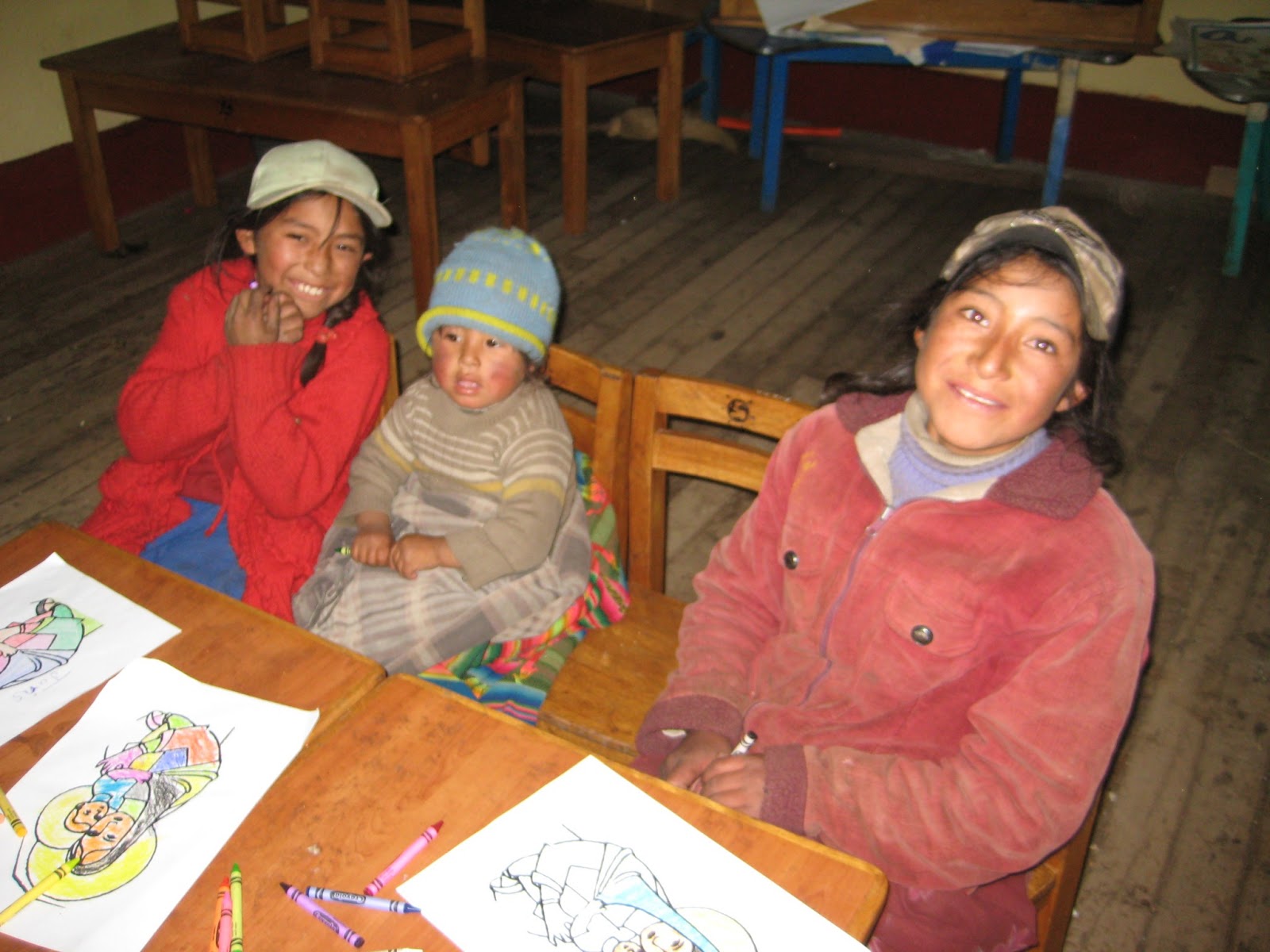
Deep in the Peruvian Andes, on a plateau at about 13,000 feet above sea level, in the department of Puno, in the scattered farming community of Pichacani (in Quecha “Who am I”), right near a newly constructed bridge, lives a young woman by the name of Juris. Her dad spends months at a time working in a notoriously life-threatening informal mine of Perú, while her mom helps farm and makes frequent trips to the market. She has 3 younger siblings: Yon Aberlin, age four, Delia, age three, and a baby of about one year. She looks out for them most of the time, cooking for them, cleaning, teaching, bringing them along to do chores, etc. Juris is ten years old, and she too plays like any other child. 

I was recently given the opportunity to assist Ricardo Simmonds, a Sodalit from Brazil, in leading a mission trip for three college students from Colorado. Juris and her family became close friends of ours.

It was difficult getting to know the community in Pichacani, as the houses are spread out, travel is slow, and the people are quite reserved. After reflecting a bit on the history of the area, we learned the people had good reason to be so. The professor and principal of the school (well, the only teacher there), who had invited us, spoke of memories he had of the Shining Path. The Shining Path was a ruthless terrorist movement that spread through the countryside of Peru mostly in the 80s, and millions fled to the cities. He told us that the teachers hid up in the hills when they came through, and they would leave decapitated bodies on the sides of the roads. The Peruvian army, he said, wasn’t much better. 

The poverty of communities and the promising salary of a miner have and still attract many of the people to mines, many of them informal, despite the well-known health problems. Peru has is one of the worlds fastest growing economies, largely due to the mines. Some of the economic growth trickles down through the different social classes, and one method of doing this is by requiring the mining companies to pay a good percentage of their profits to the local communities. However, when one encounters an indoor, heated, Olympic-sized pool that has yet to be used in the middle of the Andes, suspicion naturally arises. Indeed, much of this money is wasted due to 1) corruption and 2) lack of education to know how to use the money. Remember, the community we visited has 1 teacher for around 70 students, and he also cooks for the students and cleans the school.

Then there are those still holding to the farming tradition, and have been left… well, not exactly eager to trust every strange that comes through. The people not only endure the material poverty of malnutrition and lack of hygiene, but they are psychological scared. There remains the need for education and for spiritual accompaniment.

What brought us close to the community was our slight-dependence on them. The first day we bought a lamb and the professor helped us slaughter what would become our main food source for the week. Every bit of the lamb was eaten aside from the excrements. We also bought eggs, milk, and one day even trout from the locals. Because no trees grow at this altitude, cow chips were burned for the grill.

So why were we here? To offer what we could both materially and spiritually. Our ongoing project was planting a greenhouse of vegetables for the school we stayed at, as it was impossible to grow them in normal conditions. They raise oats, wheat, quinoa, and potatoes (which come from Peru), as well as cows, sheep, chickens, and even some trout - but no fruits or vegetables. It was summer, meaning rainy season, and it even snowed one morning. We were planning to help the neighbors plant potatoes, but the rain did not allow it.

Because the children were on vacation from classes and the houses were so spread out, we split up and walking through the countryside, meeting people, talking with them, inviting them to catechesis that we had for children and adults, and praying with them. We also handed out rosaries and prayer cards here and there, which was such a huge gift that usually we needed to insist on it being a “gift”, as in we weren’t trying to sell them something.

The mission overall was very challenging, as we stayed but a week before being exhausted from the altitude, the diet, the shortage of sleep, etc. But, it was very much an experiencing of giving everything, of seeking God's plan in our day to day situations, and experiences God's providence in all we did. On a personal level, I can say it was definitely a gift received at the right time. 


Tinajani (in Quecha "Devil's Bathtub") - A rock formation in Puno we visited just
before the mission. You could image a dinosaur coming around the corner.  


This was the very fresh milk that we drank. We usually boiled it. This was a
huge gift, as in Lima we usually drink condensed milk from a can.
Victor, the professor that invited us back for missions in Pichacani,
 taught us how to slaughter a sheep that we bought our first day. 

Our main food source for the mission. 

Fried blood with intestines, a special meal cooked for us by Victor (on the right).
He also dished up our plates very generously. All of the missionaries had a
good attitude and ate almost everything, and it actually didn't taste too bad.
Delia, who came with her sibling the first night of catechesis and stayed
for at least 3 hours. They were enough to wear us out.


One day we woke up to snow. It is summer, remember. 

I'm on a horse.

Grilling out over cow chips! A few guys came for some catechesis
and joined us in the feast afterwards. Good thing because we
wouldn't have been able to eat it all. They got home late, I suppose
they told their wives they were praying all evening :)

The creation story.

Juris (left) , Yon (her brother), and Nelga (her cousin)

One night it was raining, so we improvised a litte to make the grill work. 

It still turned out okay! 
Acting out the Nativity with the help of the kids. Yeah, we used a real
sheep in the nativity seen! 
We acted out the play first, and then we found volunteers from the children
to reenact it. This is the scourging at the pillar, just getting ready to carry his cross. 

Bravo! 

The last night we cooked all the lamb we had left and shared it with some of
the friends we had made. One of the missionaries from the U.S. brought a bag
of coats, and it was cool to be able to offer them to the group of people we
became close with. Yon (on the right) was the ornery one of the group. 

A Jesuit church in Cuzco. There are hidden treasures like
this all over Puno as well, seemingly in the middle of nowhere.
The art work inside is usually remarkable as well. Often they
are broken into and the paintings put on the black market in
Europe for thousands of dollars.  

Friday, December 21, 2012

Seeking an Encounter


So I began writing this reflection some time ago, but I'd still like to share it. With Christmas coming up, there are several activities to organize and participate in, so hopefully I can share a little bit about that shortly.

There are several things that have/are/will be happening that I can perhaps just list quickly:

1) A good friend (Carl) from the U.S. that's been here volunteering and discerning just recently returned to the states.
2) Another good friend from the states (Ian), doing the same, has also returned to the U.S.
3) Greg, recently an aspirant from Australia, has discerned for marriage and has returned to Australia.
4) David (aspirant I live with) returned from a month's "community experience", which meant divided chores again :) But, he will be entering formation in San Bartolo this coming year. As will the two aspirants from the Philippines.


The aspirants at Greg's going away party.
The group that came to Carl's going away party. It was a very warm good-bye. 

Explaining to Carl how I meant to get him a going away gift but.. 


If you haven't caught onto the pattern, the majority of the people I normally speak in English with have or will shortly be leaving. I have been blessed to have them around, as they have helped a ton in my adjustment to Perú. At the same time, the change is probably providential, because it will be a time to really be immersed in the culture (lest I become comfortable with the adjustments I have made I guess). I'm actually quite excited about this, though I know it will probably come with many difficult times.

To speak about the idea of "immersion" in another culture in general is worth reflecting on, so I'll share what I've gathered through conversations and experiences here. First a few basic things:
  • Culture is generated by human beings
  • Human beings are made for the encounter 
Me having a cultural
experience
Thus, when we immerse ourselves, when we openly encounter another culture, we become more human. Perhaps it sounds a bit theoretical, and I must admit even to me it still sounds theoretical. But, I'm excited to incarnate this in my life. It will be something good to come back to as my experience matures. 

It seems simple, but perhaps it's not so, or at the very least its not easy. It definitely doesn't happen automatically, which I think is the beauty of it all. A plane ticket to Perú does not mean I will "become more human" through a cultural encounter, or going on a mission trip anywhere, or even going to school or work in another city. I have this tendency to think that I'm obviously giving it a shot, I mean here I am in Perú. While its an amazing opportunity, it can also be a justification to others and even to myself to be content about myself or what I've done. But, what I've found necessary, is continually, actively, intentionally opening myself to the encounter. Letting who I am really affect the immediate culture around me, as well as allowing the culture to enter me. 

I have found this balance quite difficult actually, and I think in general we tend to fall into 2 extremes, though I am far from being a sociologist. 
  1. We are closed to the encounter altogether. We cling to what we know, and we reject anything foreign. Values, traditions, etc. Perhaps we are afraid of the unknown, afraid of our values being challenge, etc. I think you could call this the "ultra-conservative" approach. 
  2. We feel like we need to forget who we are, simply not claim to be anyone or claim to be of another culture, and perhaps even conform to the culture around us. Further, we must celebrate everyones culture without being critical. I've been told several times that even if i wanted to be Peruvian (which I shouldn't want to be), I never will be. The encounter where you cannot be critical (or "judge") the values or traditions of another culture. 
Quite obviously an "encounter" implies an exchange between myself and an other. The first extreme is closed off to the "other" and thus blocks an encounter with (or discovering) one's self, while the second in some way forgets about "myself" and thus cannot have an authentic experience of the other. I think I usually fall more into the 2nd. 

Certainly there exists a reconciled approach, but the cross is always necessary in reconciliation and thus a seemingly good incentive not to go there, easier to simply jump to one of the extremes. The cross is perfect because it stretches horizontally for a human encounter, but also vertically for the necessary encounter with God. The two are not opposed. 

Speaking of encounters... 

La Colecta (the collection) 

To raise money for our Christmas campaigns (celebrating Christmas in the developing areas of Lima), all the pastoral centers of the Christian Life Movement send out a team into the streets with a can, some stickers, a T-shirt, and some water. Our pastoral center sent out 600 people (mostly youth). 

The presence that we had in Lima was very cool. The campaign name is simple: "Navidad es Jesús", or "Christmas is Jesus". We all had T-shirts, and were thus easily recognizable, and the enthusiasm of the youth has to be impressive to anyone. We also gave a sticker to anyone after they donated, so after a while everyone you walked by had a sticker saying "Navidad es Jesús". 

The campaign was also very effective, as we made about $16,000 net profit. This was collected from people's pocket change. I was quite impressed by this experience, as about every other person I asked would give something. 

However, being critical, part of the experience was unnecessarily tedious. Six of us spent from 6 p.m. to 1 a.m. counting our collection (remember this is all pocket change). On one hand, I couldn't imagine collecting money in this manner in the U.S., but on the other hand, I'm quite sure we could have just dropped it off at the bank and they would have dumped it into a machine to count it. On a positive note,  not only to I not have an attraction to money now, but I actually get a bad taste in my mouth thinking about it. 

So during the collection, I found a good corner and stayed there for a while. There was also a shoe-polisher trying to get some business. After a while of observing me, he asked if i was a Gringo, I said yes, and he told me to come over. I didn't really want some Gringo treatment, so I declined. After another half hour of observing, he came over and dropped a coin in my can. I was pretty startled, and I felt like I had misjudged him, so I went over and talked with him for a while. It was a pretty legit "the poor widow gave everything she had"(Mk 12: 44) moment. I'm sorry to say I can't remember his name (it was something I hadn't heard before), but I found out he is from San Juan de Miraflores, which is a developing area that I have been working in, and one of our Christmas Campaigns will definitely be there.

It wasn't a magical conversation or anything. For one, we had to work with what Spanish I know. Also, I was trying to explain to him why I didn't have a girl friend. But I knew it was an encounter God was calling me to. I mean, I had the obvious task of collecting money, but its important to not get too "busy" with our tasks and forget to be attentive to encountering Christ, even in unexpected places (He promised to always be with us, if only we pay attention). After we were done talking and I went back to work, I was trying to explain to some people what the Christmas campaign is all about and I was having a little difficulty with the Spanish. My recently-made friend noticed, and he came over and explained the whole thing and how it was a good cause, and the people made a donation. It was very cool. 

Our "exam" in Spanish Class. RJ dosing off in the background, Greg already fast
asleep, me working diligently, and David taking advantage of me working diligently.
This is why our Spanish is so good :)


Sunday, November 25, 2012

The Greatest Mistake You Can Make…


"The greatest mistake you can make in life is to be continually fearing you will make one."
(often attributed to Elbert Hubbard)

Though I’m not sure who is responsible for forming this exact statement, and I'm sure many throughout history have pointed out this fear, but I have my high school classmates to thank for knowing it, as we chose these words for our graduation. Of course I have always liked it, and I always knew it applied to my life, but it always remained abstract. I was never quite sure how to apply it to my life, nor did I know how badly I needed to or why it was so difficult. I can almost laugh at the nonsensical fears that it speaks of, yet they haunt me like ghosts sometimes. I’m becoming aware right now of the various ways that this fear controls my actions, but I also see it with a little more depth and a little more hope.

The fear, I have found, flows directly from an attitude of perfectionism, which thrives in our culture in the States. I’m not trying to play the victim game, say it’s not my fault and there’s nothing I can do about it. But on a certain level, we do not choose the culture we are raised in, and it inevitably affects us ("independence" is unrealistic in this regard). 

Learning a new way of life, especially try to speak another language, has really required me to confront this. For this I'm thankful to be where I am. I'll share some interior activities going on in my life. Not activities specific to Perú, just happening to me while I'm in Perú :) 

Perfectionsim

When I say perfectionism, I don’t mean the idea of “striving” to be perfect, in the same way as “striving” for holiness. I mean demanding and expecting perfection, and rejecting and even fearing anything less (like mistakes). Perhaps you get what I mean, but I know I didn’t get it the first time I heard it. In any case, I’ll share the things I’m beginning to see. 

The first problem is obvious: its unrealistic. How could you be so prideful to think you will never make a mistake in life? That is absurd, and I think its necessary to laugh at ourselves a little bit when we catch ourselves thinking this.

The second is also pretty simple: who ever said making a mistake is a negative thing in itself? It’s as if we have this view that holiness equals not making mistakes. I think it’s easy to look back and find our most intense learning experiences in our mistakes. Actually, that is the key. We have the responsibility to learn from our mistakes. In that way, making a mistake is actually a positive experience. For me it has been important to see opportunity in my shortcomings. Opportunity to learn, opportunity for patience, opportunity for accept myself where I’m at.

There are a few more problems that are perhaps more at the root of the fear. A basic human pursuit is happiness, and so naturally we fear what we don’t think will make us happy, and we purse what we think will make us happy (even in a superficial way). Simple. So, why do I fear making mistakes? Because success will make me happy. I look back on my life at all the ways I’ve tried to be successful: getting good grades, practicing hard at sports, doing a job right on the farm, even in trying to lead people to God. Sure, it is gratifying when you’ve worked hard for something, and it should be. And to be clear, I don’t mean to say that success is not an evil thing; it is quite good. But God never asked anyone to be successful, only to be faithful. And there is a reason for that: because success does not equal happiness. I think it’s obvious enough when you look at the miserable lives some of the most successful people that have lived. It is the great lie disguised as the American dream: If I graduate college, get a good job, a nice house, and a family and 2-3 kids, if I do so successfully, I will be happy. This lie will pull us into a perfectionism that eats us alive.  

Finally, what I have found to be the really the source of the fear, the underlying problem of perfectionism: it is a matter of identity. It is believing that my value corresponds to my accomplishments and my shortcomings. When I complete some task successfully, I think well of myself. When I mess something up, I think less of myself. I find it hard to simply accept and value myself as I am. As I mentioned earlier, its absurd to think I will never make a mistake. And the true is that who I am will make mistakes. Because I fear making mistakes, I won’t accept who I am here and now, I won’t accept my limits, but rather I create an ideal image of myself that never messes up, and I will only accept myself as that person (which is not me). If that’s a little confusing, perhaps you can at least see the vanity in it all.

Perhaps an example from my childhood: I would always imagine myself making amazing receptions in sideline football, or breaking tackle after tackle, make the perfect cuts, and everyone would be impressed and know what I’m capable of, because I was capable of this. But, the truth is, the good plays I made could have been more perfect, and there were always some bad plays. It was frustrating because it was never the perfection I imagined. I think I carried this with me through high school sports.

Anyways, you can see there is an endless frustration with myself, an endless sources of fears, and they will never be put to rest until I accept and value who I am, not who I want to be.

The only questions I can really bring myself back to, then, are: Who am I? Where does my value come from? Am I, simply me, in myself, aside from my performance, significant? When did I become something/someone valuable?

They are serious questions, and I think what is important is not necessarily being able to give the answer on the spot, but knowing that these are the most important questions of my life and I must give everything I have to answer them. We all find the longing within ourselves to know ourselves, and to be significant, to matter, to be valuable. The mistake is to not follow these longings. 

For Further Reflection.. 

Perhaps I will start a tradition of attaching songs to my reflections. At least I will for this one. At your own leisure, Casting Crowns proposes an answer to the previous questions: 


A practical exercise I've been doing: 

Let others see my mistakes. Stop trying to hide them. It keeps me honest with myself. 

For the year of faith, we had an "intellectual soccer" competition with all the parish centers in Peru. Basically you form
a team of 6 guys and study the documents proposed and be prepared to answer questions from them. We used a minor
Catechism prepared by the diocese, along with Porta Fidei and Fidei Depositum. Basically, you gott know the faith.
In Spanish :) Our team was from 4 different countries (US, Australia, Philippines, Peru). 


We had a ping pong tournament in the Parish Center. Brought
back some good memories of playing with my dad back in the day.